For TokenVerse, that experiment was a simple web prototype designed to test one idea:
Could an AI system be understood as a workplace?
The first prototype placed players behind the front desk of a fictional AI company. Incoming user requests arrived one after another, and players decided which department should handle them. It was a quick way to test whether turning invisible AI processes into workplace tasks could make them easier to understand.
Learning from the first prototype
The prototype successfully answered one question: the workplace metaphor was intuitive. Players quickly understood the idea of becoming an employee inside an AI company instead of simply chatting with an AI assistant.
However, it also exposed an important design problem.
The departments in the prototype were organized around task categories, assuming that different kinds of requests were handled by different parts of the model. After studying GPT architecture in much greater depth, I realized this wasn't an accurate representation of how modern large language models actually operate.
Instead of discarding the metaphor, I redesigned it.
Designing the AI Company
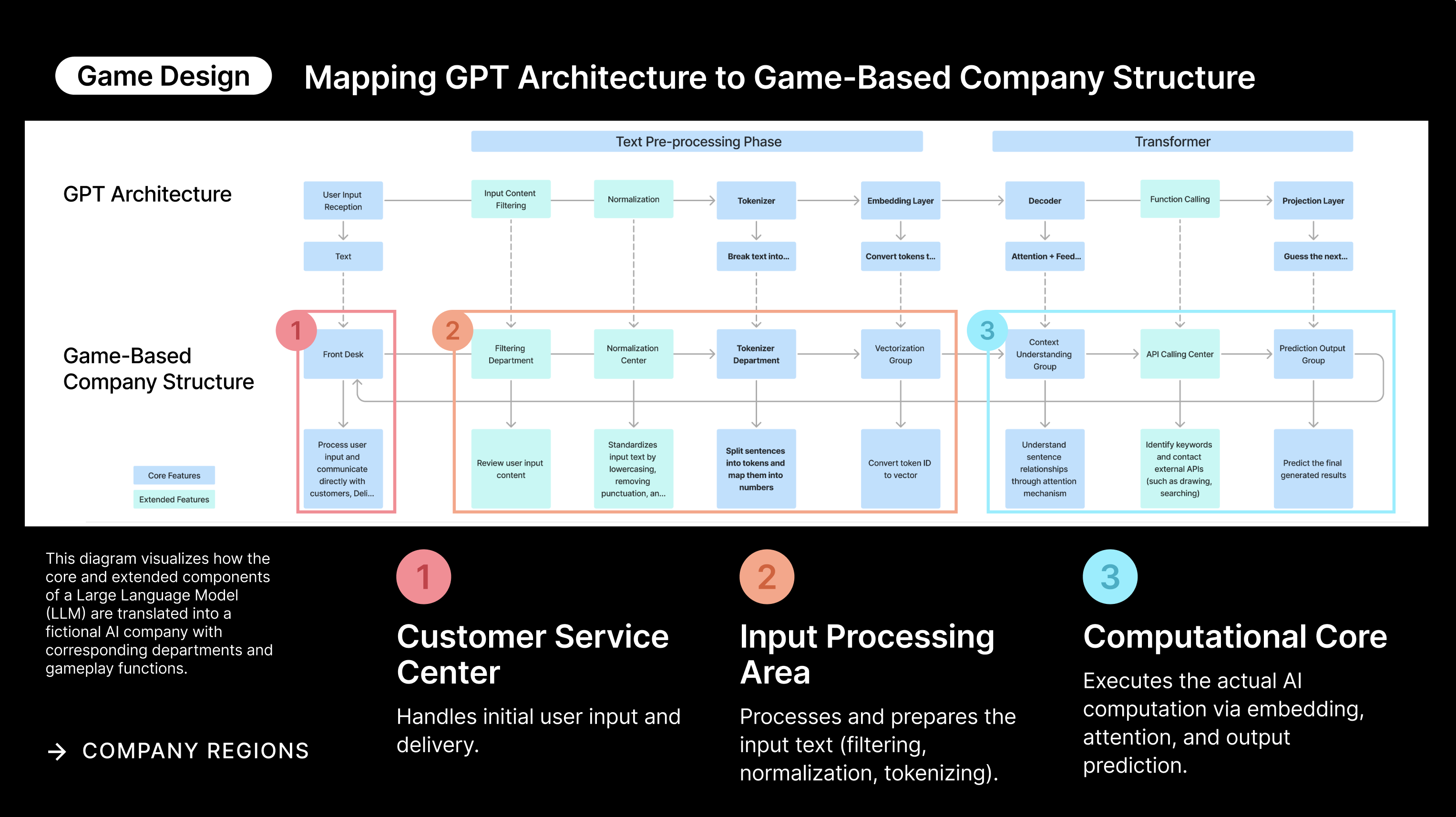
Rather than organizing the company around user tasks, I began mapping the actual workflow of a large language model into a fictional organization.
Core components such as input processing, tokenization, embeddings, transformers, decoding, safety systems, and response generation became departments inside the company. Each department represented a real stage in the model's pipeline while remaining understandable through gameplay.
This mapping became the foundation of TokenVerse.
From diagrams to a place you could explore
Once the company structure was defined, the next challenge was giving it a physical form.
Instead of explaining GPT through static diagrams, I wanted players to explore the system as if they were walking through a workplace. Different departments occupied different spaces, NPC employees represented internal AI components, and progression through the building mirrored the flow of information inside a language model.
This became the first 3D prototype of TokenVerse.
It introduced many ideas that still exist today:
- A fully explorable AI company
- Employees representing different AI functions
- Interactive mini-games connected to AI concepts
- Progression through different departments as players learn more about the system
Looking ahead
The prototype was still far from the game TokenVerse is today.
Many mechanics would later change, new chapters would be added, and the learning goals would evolve. But the central idea remained the same:
Understanding AI by stepping inside the system instead of looking at it from the outside.
The next chapter of the project would move beyond a single prototype and begin transforming this design framework into a much larger educational game.
Back to News